Emotion Detection: Multi-class classification and Quantization
Emotion Detection
HAUS
This is a multi-class classification model for Snapchat Filter. It has around 0.75 accuracy and is relatively small, 2.7 MB, designed to run on mobile devices in real time.
It is possible to get higher accuracy models with bigger size. This project focused on getting the smallest size (<10MB) and keeping the accuracy.
Dataset
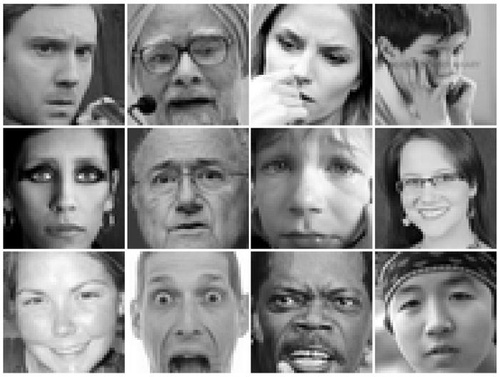
FER2013 is a dataset for Facial Expression Recognition, released by Goodfellow in 2013. The data consists of 48x48 pixel grayscale images of faces. The faces have been automatically registered so that the face is more or less centred and occupies about the same amount of space in each image.
The task is to categorize each face based on the emotion shown in the facial expression into one of seven categories (0=Angry, 1=Disgust, 2=Fear, 3=Happy, 4=Sad, 5=Surprise, 6=Neutral). The training set consists of 28,709 examples and the public test set consists of 3,589 examples.
Model
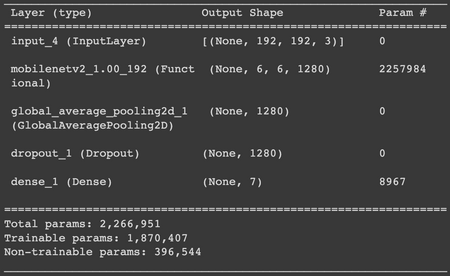
Used Keras MobileNetV2 backbone and transfer-learned on ImageNet
Data Augmentation: EDSR
Initial 48x48 dataset showed low accuracy (~0.6) so I upscaled and refined FER2013 dataset.
Refinement
The dataset had error images such as loading error image of the image url, or simple line drawings instead of photos. Some had wrong category labels as well. After removing error data and moving some of them to right category, accuracy improved.
EDSR
EDSR stands for Enhanced Deep Residual Networks for Single Image Super-Resolution. It upscales images with great quality. I upscaled 48x48 pixel images to 192x192 pixels, without losing much information. This is 16 times of upscaling.


After data augmentation and preprocessing, accuracy raised up to 0.8 with training sets.
Quantization
Quantization for deep learning is the process of approximating a floating point (normally 32bits) neural network with lower bit values (16bits or 8bits). This drastically reduces both the memory requirement and computational cost of the network.
1. Post-training quantization
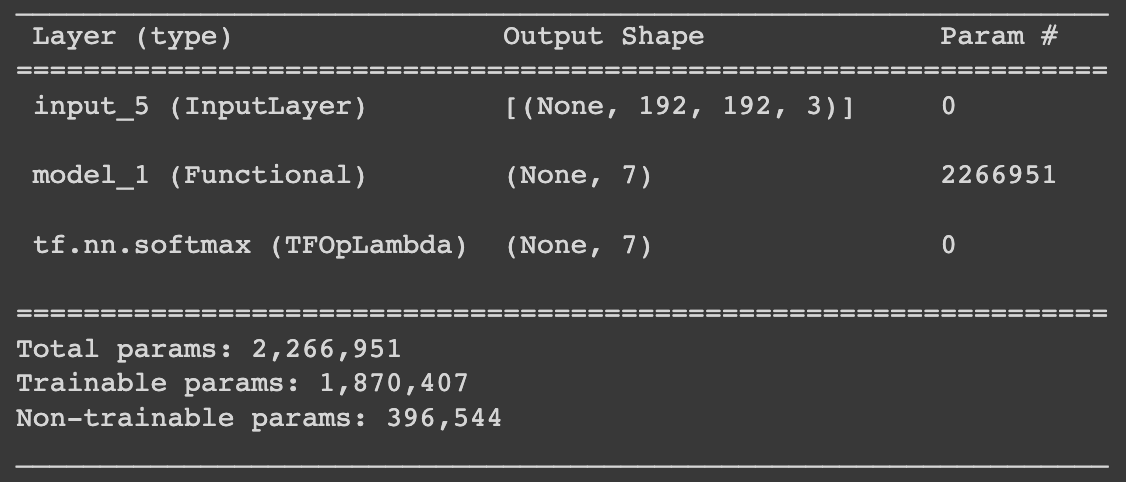
Post Training quantization requires a representative dataset to estimate the range, i.e, (min, max) of all floating-point tensors in the model so that we can establish a better mapping from floating point to integer space.
2. Quantization aware training
Quantization aware training simulates the lower precision behavior in the forward pass of the training process. This introduces the quantization errors as part of the training loss, which the optimizer tries to minimize during the training. Thus, QAT helps in modeling the quantization errors during training and mitigates its effect on the accuracy of the model at deployment.
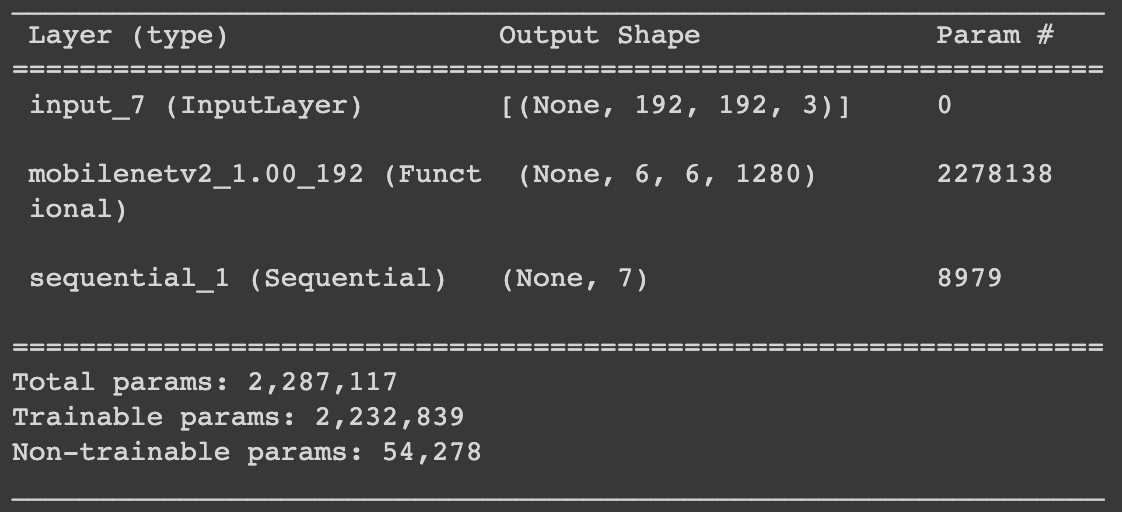
- 8.5MB Original
- 2.6MB Post-training quantization
- 2.7MB Quantization aware training
Optimization
Facial Landmarks
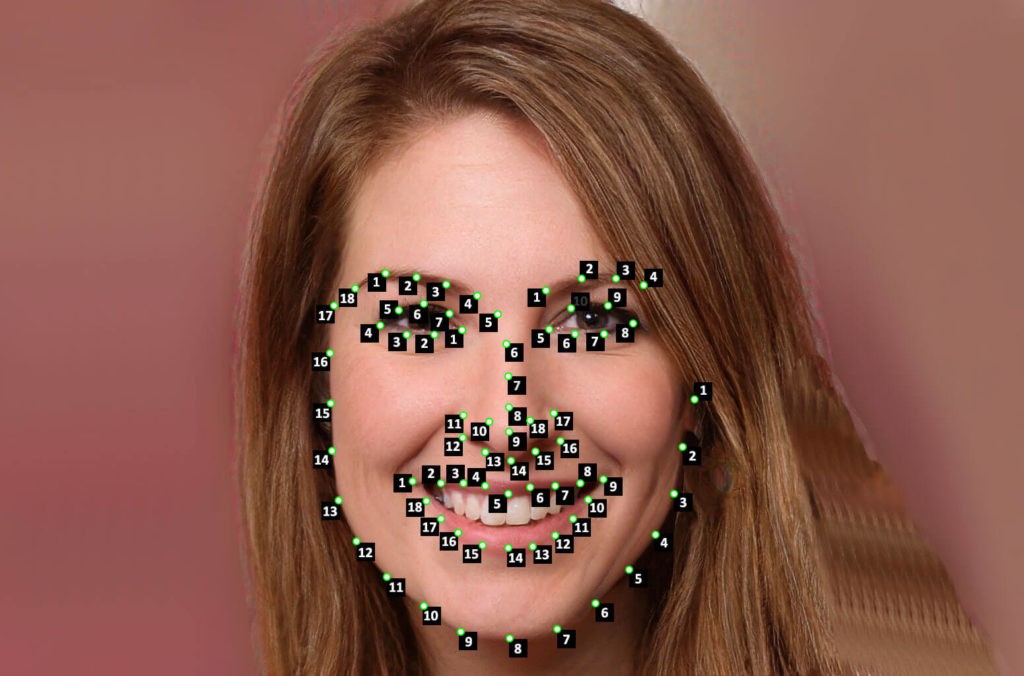
When we only train with cropped face images, we can expect some classification challenges; they all look similar in terms of human faces. It would be easier to classify according to sex and age, but facial expressions are subtle. Facial landmarks are coordinates of eyes, eyebrows, nose, mouth, and contour. Especially positions of eyes, eyebrows, and mouth show notable changes compared to image pixels of photos. We can add these facial landmark coordinates as concatenated input to the image pixel information. There are several papers showing enhanced performance.

MobileNetV3
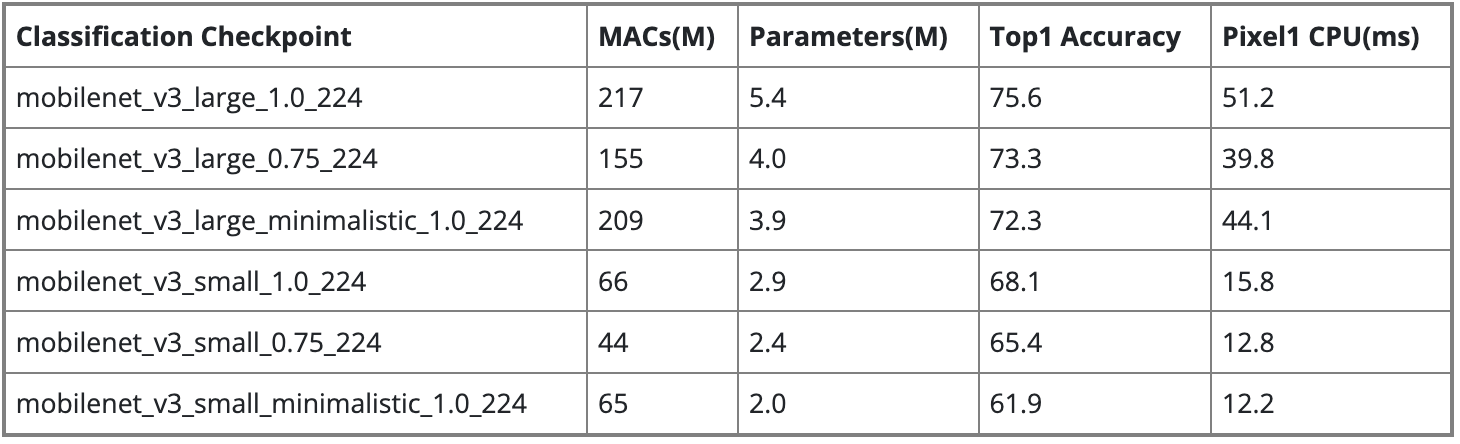
MobileNetV3 shows better accuracy and running time. We can use it as backbone for custom data training.
CK+ (Extended Cohn-Kanade dataset)
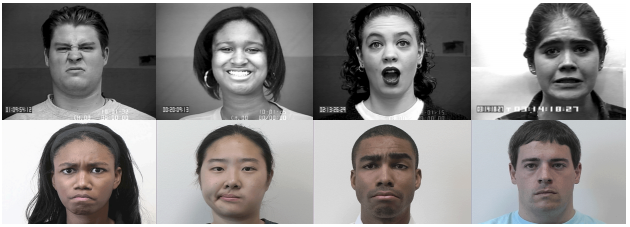
The Extended Cohn-Kanade (CK+) dataset contains 593 video sequences from a total of 123 different subjects, ranging from 18 to 50 years of age with a variety of genders and heritage. Each video shows a facial shift from the neutral expression to a targeted peak expression, recorded at 30 frames per second (FPS) with a resolution of either 640x490 or 640x480 pixels. Out of these videos, 327 are labelled with one of seven expression classes: anger, contempt, disgust, fear, happiness, sadness, and surprise. The CK+ database is widely regarded as the most extensively used laboratory-controlled facial expression classification database available, and is used in the majority of facial expression classification methods.
References
snapml-templates
FER-2013
EDSR in Tensorflow
Emotion detection using facial landmarks and deep learning